
Electromagnetic Vibrating Conveyor:Working Principle & Features
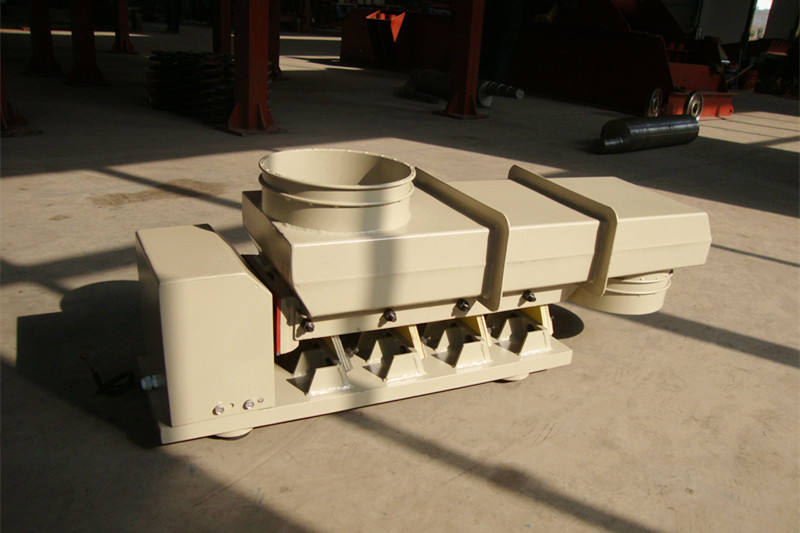
Anelectromagnetic vibrating conveyoris a continuous conveying machine designed to transport bulk materials through controlled vibration. It is widely used for handling powdery, granular, and small lump materials in industrial production lines.
The conveyor uses an electromagnetic drive to generate controlled vibration. This vibration causes materials to move forward along the conveying trough. As a result, the machine provides stable, uniform, and continuous material conveying with relatively low power consumption.
What Is an Electromagnetic Vibrating Conveyor?
An electromagnetic vibrating conveyor uses an electromagnetic exciter as its main drive system. The electromagnetic force generates periodic vibration of the conveying trough. Under the combined action of vibration and gravity, materials move continuously from the feeding point to the discharge point.
Compared with conventional mechanical conveying equipment, the electromagnetic vibrating conveyor has a relatively simple structure. It also allows flexible control of the conveying speed by adjusting the vibration intensity.
This makes it suitable for applications that requireaccurate, continuous, and uniform material feeding.
What Is a Vibrating Conveyor?
A vibrating conveyor is a type of bulk material handling equipment that uses controlled mechanical vibration to move materials along a conveying surface. It can transport a wide range of materials, including powders, granules, small lumps, and other bulk solids.
Depending on the application, vibrating conveyors can use different vibration drive systems, such as electromagnetic, unbalanced motor, or mechanical exciters. Among them, electromagnetic vibrating conveyors are particularly suitable for applications that require precise feeding and easy control of material flow.
Vibrating conveyors are commonly used to transfer materials between different stages of a production line. They can also be designed for feeding, conveying, cooling, screening, or distributing materials. Their enclosed or customized configurations make them suitable for applications where dust control, hygienic conveying, or special process requirements are important.
Compared with some conventional conveying equipment, a mining conveyor has a relatively simple structure and can provide reliable continuous material movement. It is widely used inmining, metallurgy, coal, building materials, food processing, chemical, and machinery industries.
Working Principle of Electromagnetic Vibrating Conveyor
The electromagnetic drive produces periodic excitation through electromagnetic force. The conveying trough then vibrates at a specific frequency and amplitude.
When the trough moves in the designed direction, the material receives an upward and forward force. The material moves forward through repeated throwing and falling movements.
By adjusting the vibration parameters, operators can control the material flow rate according to production requirements.
The conveying process can be summarized as follows:
- Bulk material enters the conveying trough from the feeding equipment.
- The electromagnetic exciter generates controlled vibration.
- The trough transfers the vibration to the material.
- The material moves forward continuously along the trough.
- The material reaches the discharge end and enters the next process.
The conveying speed can be adjusted according to material characteristics and production requirements.
Main Features of Electromagnetic Vibrating Conveyor
1. Uniform and Continuous Conveying
The electromagnetic vibrating conveyor provides stable material flow. It is especially suitable for production lines that require continuous feeding and precise material distribution.
2. Simple and Compact Structure
The machine has a relatively simple structure and requires fewer mechanical transmission components. This makes installation and operation convenient.
3. Low Power Consumption
The electromagnetic drive can operate with relatively low energy consumption. Therefore, the conveyor can help reduce operating costs in continuous production applications.
4. Easy Maintenance
The equipment has fewer moving mechanical parts than many traditional conveying systems. It requires no conventional mechanical lubrication for the conveying mechanism, which simplifies routine maintenance.
5. Low Wear
The controlled vibration reduces the need for continuous mechanical friction between transmission components. This helps reduce mechanical wear and extend service life.
6. High-Temperature Resistance
Depending on the equipment configuration and material selection, electromagnetic vibrating conveyors can handle materials at elevated temperatures. This makes them suitable for certain metallurgical, building material, and industrial processing applications.
7. Flexible Installation
The conveyor can be arranged according to the production process. It can also be designed with multiple feeding or discharge points when required.
8. Suitable for Automatic Production Lines
The electromagnetic vibrating conveyor can be integrated with automatic control systems. By linking the vibration intensity with other production equipment, it can support automatic and continuous material handling.
Conclusion
An electromagnetic vibrating conveyorprovides a reliable solution for continuous conveying of powdery, granular, and small lump materials. Its simple structure, low power consumption, easy maintenance, low wear, and flexible control make it suitable for a wide range of industrial applications.
With the right configuration, the conveyor can also be integrated into multi-point feeding, multi-point discharge, and automatic control systems, making it a practical choice for modern bulk material handling and continuous production lines.