
Circular Vibrating Screen :Main Componen ,Applications & Features
What Is a Circular Vibrating Screen?
ACircular Vibrating Screenis a screening machine used to separate and classify bulk materials according to particle size. It is widely used in mining, quarrying, aggregate production, construction, metallurgy, and other industries.
The screen body moves in a circular or elliptical motion during operation. This vibration causes materials to continuously move, rotate, and toss across the screen surface. Smaller particles pass through the screen openings, while larger particles move toward the discharge end.
Because of its efficient screening motion and robust construction, a circular vibrating screen is particularly suitable for processing crushed stone, gravel, sand, ores, and other bulk materials.
How Does a Circular Vibrating Screen Work
A circular vibrating screen uses a vibration exciter to generate a controlled circular motion. The vibration is transferred to the screen body and screen surface.
When material enters the screen, the vibration causes it to spread across the screening surface. The material repeatedly moves upward and forward before falling back onto the screen.
During this process:
- Fine particles pass through the screen openings.
- Larger particles remain on the screen surface.
- Repeated vibration improves material stratification.
- Oversized material moves toward the discharge end.
- Different particle sizes can be separated through multiple screening decks.
This continuous motion allows the machine to process large quantities of material efficiently.
Why Does Circular Motion Improve Screening
The circular movement creates a continuous throwing and rolling action on the screen surface. This helps spread the material and gives particles more opportunities to contact the screen openings.
The movement is particularly useful when processing irregular or relatively coarse materials.
It can also help reducescreen blinding, which occurs when particles block the screen openings and reduce the effective screening area.
By keeping the material moving continuously, a circular vibrating screen can maintain good screening efficiency under demanding operating conditions.
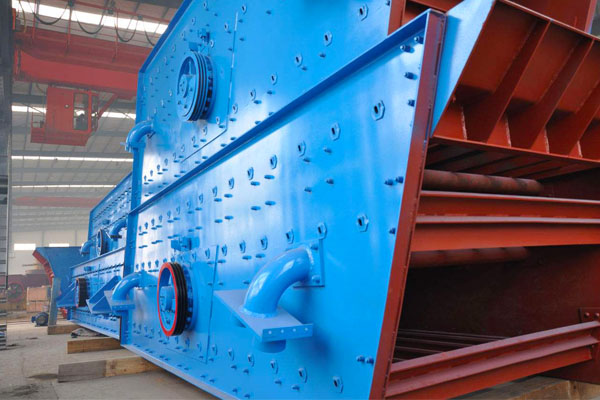
Main Components of a Circular Vibrating Screen
A typical circular vibrating screen consists of several major components:
- Screen box
- Screen mesh or screen panels
- Vibration exciter
- Vibrating motor or drive system
- Springs or supporting elements
- Side plates
- Feed inlet
- Discharge outlets
- Supporting frame
Each component plays an important role in maintaining stable vibration and reliable screening performance.
Key Features of Circular Vibrating Screens
Circular vibrating screens are widely used because they combine relatively simple construction with strong screening performance.
Key advantages include:
- High screening capacityfor large-volume applications
- Efficient material stratificationduring screening
- Reduced screen blindingunder suitable operating conditions
- Robust constructionfor demanding environments
- Multiple screening decksfor classifying different particle sizes
- Flexible screen media options
- Stable and continuous operation
- Easy integration into crushing and screening plants
The actual capacity and screening efficiency depend on factors such as material characteristics, feed rate, moisture content, screen aperture, deck configuration, and operating parameters.
Applications of Circular Vibrating Screens
Circular vibrating screens are commonly used in industries that require continuous classification and separation of bulk materials.
Typical applications include:
Mining
Circular vibrating screens can separate ores and other mined materials into different size fractions before or after further processing.
Quarrying
In aggregate plants, they are widely used to classify crushed stone, gravel, and sand.
Aggregate Production
They can separate aggregate products into different sizes for concrete, road construction, and other applications.
Construction Materials
Circular vibrating screens can process crushed construction materials and recycled aggregates.
Metallurgy
They can be used for screening and classifying various mineral and metallurgical materials.
Circular Vibrating Screen in a Crushing and Screening Plant
A circular vibrating screen is often used as part of a complete crushing and screening system.
A typical process may include:
Feeding → Primary Crushing → Secondary Crushing → Screening → Final Products
After crushing, the material enters the vibrating screen. The screen separates the material according to particle size.
Oversized particles can be returned to the crusher for further processing, while qualified particles are discharged as finished products.
This closed-loop configuration helps improve product size control and overall plant efficiency.
How to Choose a Circular Vibrating Screen?
Selecting the correct circular vibrating screen requires consideration of several technical factors.
| Selection Factor | Importance |
| Feed capacity | Determines the required screening area |
| Material type | Influences screen media and machine configuration |
| Particle size | Determines the appropriate screen aperture |
| Moisture content | Affects screening efficiency and potential clogging |
| Number of decks | Determines how many size fractions can be produced |
| Screen area | Influences processing capacity |
| Material density | Affects loading and screening performance |
| Installation space | Determines the suitable machine dimensions |
The required screening capacity should be calculated according to the actual material characteristics and production requirements.
Maintenance of Circular Vibrating Screens
Regular maintenance helps keep a vibrating screen operating reliably and extends the service life of key components.
Operators should regularly inspect:
- Screen mesh and screen panels
- Springs
- Vibration exciter
- Bearings
- Fasteners
- Drive components
- Side plates
- Discharge outlets
Screen panels should be replaced when they become excessively worn or damaged. Loose bolts and fasteners should also be tightened promptly.
Abnormal noise, excessive vibration, overheating, or unstable movement may indicate a mechanical problem. These issues should be inspected before they develop into more serious failures.
How to Improve Screening Efficiency?
Several factors can influence the performance of a circular vibrating screen.
To improve screening efficiency:
- Maintain an appropriate feed rate.
- Distribute material evenly across the screen.
- Select suitable screen openings.
- Avoid excessive material loading.
- Keep the screen surface clean.
- Monitor material moisture.
- Replace severely worn screen panels.
- Maintain the vibration system properly.
- Adjust operating parameters according to the material.
Correct feed distribution is especially important. Uneven feeding can overload part of the screen while leaving other areas underutilized.
Conclusion
A Circular Vibrating Screen is an efficient screening machine designed to separate bulk materials according to particle size. Its circular vibration causes materials to move, rotate, and toss continuously across the screen surface.
This movement promotes material stratification and helps reduce screen blinding, making circular vibrating screens suitable for demanding applications inmining, quarrying, aggregate production, construction, and metallurgy.