
Key Difference between circular vibrating screen and linear vibrating screen
Screening equipment plays a vital role in bulk material processing by performing classification, dewatering, and desliming operations. Among the various screening machines available, circular vibrating screens and linear vibrating screens are the two most widely used.
Although both machines separate materials through the vibration of a screening surface and share similar external structures, they differ significantly in the way materials move across the screen. This difference directly affects screening efficiency, processing capacity, material flow, and suitable applications.
Equipment Overview
Circular Vibrating Screen (Single-Shaft Vibrating Screen)
A circular vibrating screen is a high-efficiency screening machine designed for multi-layer material classification. During operation, the material travels across the screen surface in a circular or elliptical motion, which improves particle stratification and screening efficiency.
The machine uses an inertia exciter to generate vibration. Since the exciter contains only one main shaft, it is also known as a single-shaft vibrating screen.
Circular vibrating screens are widely used in mining, coal processing, metallurgy, aggregates, and construction materials. They are especially suitable for grading crushed materials at different stages of a crushing plant.
Linear Vibrating Screen (Double-Shaft Vibrating Screen)
A linear vibrating screen uses two horizontally mounted vibration motors as its excitation source. Through the self-synchronization of the dual motors, the screen box vibrates in a straight line, causing materials to move forward in a uniform linear motion while continuously jumping on the screen surface.
Because the vibration system consists of two shafts with eccentric blocks, this machine is also referred to as a double-shaft vibrating screen.
Linear vibrating screens are mainly designed for screening and grading powders and fine granular materials. They are widely used in chemical processing, food production, pharmaceuticals, abrasives, grain processing, and fertilizer manufacturing.
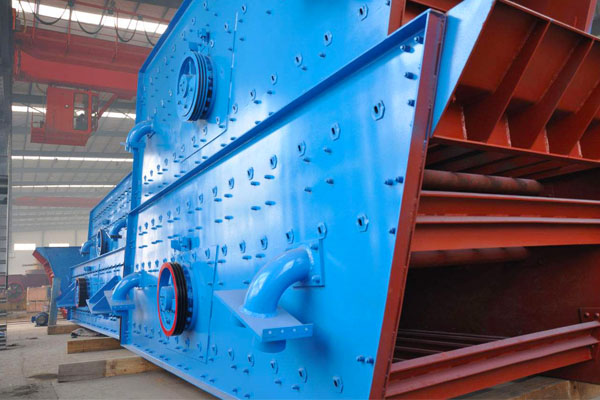
Key Difference between circular vibrating screen and linear vibrating screen
1. Material Movement
The most fundamental difference lies in the movement of the material.
A circular vibrating screen moves materials in a circular or elliptical trajectory, while a linear vibrating screen transports materials forward in a straight line.
Different material movement patterns result in different screening performance and application ranges.
2. Excitation System
A circular vibrating screen uses a single-shaft inertia exciter to generate circular vibration, which is why it is commonly called a single-shaft vibrating screen.
In contrast, a linear vibrating screen adopts two synchronized vibration motors that drive a pair of eccentric shafts to create linear motion. For this reason, it is also known as a double-shaft vibrating screen.
3. Screen Blinding Resistance
Circular vibrating screens are generally more effective at preventing screen blockage.
Their circular throwing motion disperses materials more evenly and increases particle bouncing. As a result, particles trapped in the screen openings are more likely to break free, significantly reducing screen blinding and improving continuous screening performance.
4. Installation Layout
Linear vibrating screens usually operate with a smaller screen inclination angle, resulting in a lower overall machine height.
This compact structure makes them easier to integrate into production lines and simplifies plant layout, especially where installation space is limited.
5. Screen Inclination Angle
Circular vibrating screens allow operators to adjust the screen inclination angle according to the particle size and processing requirements.
Changing the inclination angle controls the material conveying speed across the screen surface and helps increase processing capacity.
By comparison, linear vibrating screens generally operate with a relatively small and fixed screen angle.
6. Construction Materials
Circular vibrating screens are built for heavy-duty applications.
Manufacturers typically use thicker steel plates, while the screen box is commonly fabricated from high-strength manganese steel to withstand the impact of large, heavy materials.
Linear vibrating screens are generally lighter in construction and are often manufactured from light structural steel or stainless steel, depending on the application and material characteristics.
7. Typical Applications
Circular vibrating screens are primarily used to process large, heavy, and hard materials. They are widely applied in mining, coal preparation plants, quarries, and aggregate production.
Linear vibrating screens are better suited for fine particles, lightweight materials, powders, and granules. They are commonly used in industries such as food processing, chemicals, pharmaceuticals, fertilizers, and building materials.
Conclusion
Although both circular vibrating screens and linear vibrating screens fall under the category of mining vibrating screens and utilize vibration for material separation, their respective designs are tailored to distinct operating conditions.
A circular vibrating screen offers excellent handling capacity, superior resistance to screen blinding, and outstanding performance when processing coarse, heavy, and abrasive materials. It is the preferred choice for mining and aggregate applications.
A linear vibrating screen, on the other hand, provides stable linear conveying and high screening accuracy for fine particles and powders. Its compact design also makes installation more convenient in production facilities with limited space.
Selecting the right vibrating screen ultimately depends on your material characteristics, particle size, production capacity, and process requirements. Understanding the strengths of each design will help maximize screening efficiency and improve overall production performance.