
Top 4 Advantages of Inertial Vibrating Hot Material Conveyor
The inertial vibration hot material conveyor is a long-distance vibrating conveying device that integrates material conveying and airlock functions. It is specifically designed for the continuous conveying of high-temperature, highly abrasive granular materials.
This equipment uses two vibrating motors as the excitation source. Based on the self-synchronization control principle, the synchronous counter-rotation of the two motors creates a symmetrical centrifugal force field in space. After mechanical decomposition, this force field drives the balance frame at the bottom of the conveyor to generate directional reciprocating vibration (the vibration direction is perpendicular to the motor shaft). Then, through the synergistic action of the main vibration spring and guide leaf spring, the vibration is precisely transmitted to the upper conveying trough, causing the material in the trough to achieve continuous and uniform sliding or throwing motion along a predetermined direction under the combined action of inertial force and friction.
Inertial vibration hot material conveyors integrate vibration conveying with airlock functions—through a fully enclosed trough structure and stable low-frequency vibration, a reliable material sealing effect is formed at the discharge end, effectively preventing the escape of high-temperature gas or dust during the conveying process. They are well-suited for airlock conveying of high-temperature materials and meeting the airtightness requirements of thermal systems in industries such as cement and metallurgy.
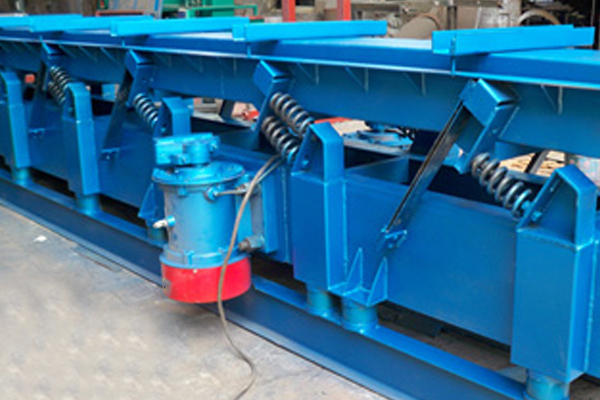
Top 4 Advantages of Inertial Vibrating Hot Material Conveyor
Simple Structure and User-Friendly Maintenance
- Simple Design: No complex transmission components (such as gears, chains, belts), consisting only of a vibrating motor, spring supports, and the trough. The equipment is lightweight (30%~50% lighter than belt conveyors with the same conveying capacity);
- Low Wear: The material contacts the trough through "vibration sliding" (not sliding or rolling friction), resulting in a low trough wear rate (annual wear ≤0.5mm). Key components (such as springs and motor bearings) have a lifespan ≥3 years;
- Easy Maintenance: The vibrating motor uses a modular design (quick disassembly and assembly). Routine maintenance only requires checking bolt tightness and lubrication (only lithium-based grease needs to be added to the motor bearings every six months). Maintenance downtime is <2 hours.
Long Distance, High Capacity, Energy-Saving, and Low-Noise Operation
- Conveying Capacity: A single unit can convey materials horizontally over distances of 20-30m (extended to 50m with special designs), with a conveying capacity ranging from 5-200t/h (adjustable based on trough width and amplitude), meeting the transfer needs of high-volume materials such as cement clinker (particle size ≤50mm) and metallurgical slag (particle size ≤80mm).
- Energy Efficiency: The vibratory motor power is only 3-15kW (40%-60% more energy-efficient than belt conveyors of the same specifications), and the amplitude and frequency are adjustable (motor speed controlled by a frequency converter), allowing for precise matching of conveying efficiency for different materials.
- Low-Noise Operation: After vibration isolation via springs, the ambient noise level around the equipment is ≤75dB(A) (at 1m from the equipment), far lower than belt conveyors (≥85dB(A)) or screw conveyors (≥90dB(A)), meeting environmental workshop noise standards.
High Temperature Adaptability and Reliable Air Lock
- High Temperature Resistance: The tank body can be made of Q235 steel plate (≤300℃), 310S stainless steel (≤600℃), or coated with refractory materials (such as an alumina ceramic layer). Combined with natural cooling or air-cooled jackets (optional), it can directly transport high-temperature hot materials ≤500℃ (such as cement kiln head clinker and blast furnace slag) without hot-state commissioning (stable conveying state is achieved within 5 minutes after cold start).
- Air Locking Effect: The fully enclosed tank body and the "material sealing barrier" formed by low-frequency vibration ensure that the airflow leakage at the discharge end is ≤0.5m³/(m²·min) (far lower than the 1~3m³/(m²·min) of conventional air lock valves), making it particularly suitable for process systems connected in series with high-temperature fans and dust collectors (such as hot raw material conveying in cement kiln tail preheaters).
Stable and reliable, flexible operation
- Start-stop characteristics: The vibratory motor has a low starting current (1.2~1.5 times the rated current), allowing the equipment to start/stop quickly within 1~2 seconds without impact (vibration acceleration ≤5g), avoiding material accumulation or sudden pressure changes in pipelines;
- Multi-point feeding/discharging: Supports adding a feed inlet in the middle of the tank (using special guide plates to avoid material backlash), achieving flexible layouts of "one-point feeding, multiple-point discharging" or "multiple-point feeding, one-point discharging," adaptable to complex process flows;
- Vibration isolation compatibility: By adjusting the spring stiffness and damping parameters, the equipment achieves a vibration isolation efficiency of ≥80% for the installation foundation (vibration transmission rate ≤0.2), allowing direct installation on floors, steel structure platforms, or sites where old equipment is being retrofitted (no large concrete foundation required).
Conclusion
General-purpose vibratory conveying equipment, specifically inertial vibratory hot material conveyors, boasts advantages such as simple structure, convenient operation and maintenance, and strong adaptability. Through self-synchronous vibration technology, stable design over the resonance zone, fully enclosed airlock structure, and multi-material compatibility solutions, it has become a key piece of equipment in the material transfer process of modern industrial production lines.